
Deputy editor George Barker reports on a useful document from the multi-award-winning SMP Alliance cataloguing the challenges and lessons learned on the way to its success.
Conceived as a ‘contemporary delivery vehicle' for the Government's Smart Motorway Programme (SMP), the SMP Alliance (winners of no less than three awards at the 2025 Highways Awards) was forced to pivot and take on the National Emergency Area Retrofit (NEAR) programme.
Now nearing the end of all anticipated work and preparing for handover this spring, the alliance has published a legacy and learning document to allow others to learn from their experiences.
Comprising a partnership between seven members – National Highways (initially Highways England), Fluor, WSP, Jacobs, Balfour Beatty, Costain and the BAM Morgan Sindall joint venture – and more than 100 suppliers, the alliance was entrusted with 92.8% (£362m) of the total £390m allotted by the Government for the NEAR programme to design and construct 138 of the 150 additional emergency areas (EAs) on all-lane running motorways.
The SMP Alliance and its supplier partners successfully delivered the NEAR programme safely, on time and within funding. Construction started in June 2023, completing just 22 months later in March 2025, with the blended teams managing to compress a five-year national programme to just three years and with two million RIDDOR-free hours achieved.
A key early stage for building the alliance was the development of the contract. Based on the NEC4 Alliance model, the partners sought to utilise as much of the original document as possible. Included in this was the Implementation Plan, which the group advises future alliances to take full advantage of, as it is designed to be a ‘live document' and can be updated regularly to reflect the evolving needs of the alliance. This provided the alliance with the ‘necessary flexibility' to ‘establish and form its "best for" ways of working'.
However, the legacy and learning document notes that, given the chance again, the alliance would make sure to be more explicit about the drafting requirements when setting up the contract. It said that some of the drafting undertaken by National Highways' experts didn't align with the intent of the alliance model, leading to significant redrafting and delays. To avoid this, care should be taken to ensure the drafters understand what is needed and a step to check progress could be introduced to ensure that ‘things were progressing in the right way'.
Between 2021 and 2024, the SMP Alliance was working on introducing an extra lane in both directions of the M6 between junctions 21a and 26. With the use of on-site technology such as Varioguard road barriers and HoloLens augmented reality headsets, the team ensured that the hard shoulder was converted efficiently, sometimes with as few as one crew member actually on site.
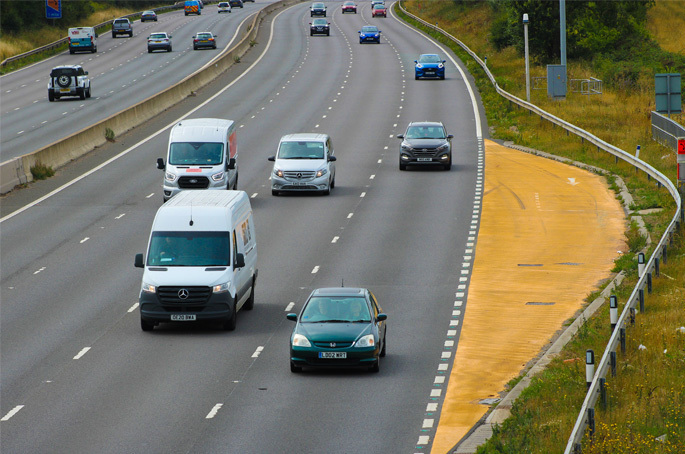
The team was able to build the 12 EAs along this stretch of the M6 ‘faster and cheaper' than anywhere else, as the ‘mini EAs' which were used here were trialled on a compound first, allowing the alliance to identify issues and improve efficiency before constructing them on the road.
Challenges arose from this M6 scheme being designed outside of the alliance, which led to issues with compliance and handover due to it not being ‘set up according to the alliance's standards'. The legacy document also mentions that it is best to ensure that the signage supplier's contract includes maintenance as well as supply and installation, as neither the contractor nor the area's teams were responsible for signage maintenance, leading to later issues.
A key part of the programme was the delivery of the stopped vehicle detection (SVD) retrofit. By adopting a ‘programmatic approach', the alliance teams were able to use standardisation and off-site assembly to promote ‘safety, flexibility and efficiency with reduced carbon'. On reflection, the alliance recommends stronger communication between stakeholders, especially for a project that is spread across the country such as this, as it could have made handovers between stages less painful and more effective.
The SVD retrofit was delivered safely, with zero lost time incidents in roughly 500,000 hours and with zero service strikes. The team also had no environmental incidents and the programme delivered a carbon saving of 24%, well over its target of 3%.
Another project that the SMP Alliance was able to learn a lot from was the delivery of the M40/M42 Interchange and the M42 junctions 4 to 7 dynamic hard shoulder enhancement, which was able to be delivered early, thanks to innovations both on and off site.
As the scheme's senior design manager explains: ‘We met our own target of completing more off-site construction because we wanted to improve safety, realise efficiencies, increase productivity, minimise risks and deliver greater programme certainty. The solution – combining precast foundations, above-ground rigid concrete barriers and a purpose-built, HAVS-free drilling rig – helped us meet our ambitions.
‘At the M40 / M42 Interchange, we set a new benchmark for safe, efficient delivery with the 10.5km installation completed three months early. We trialled the new barrier system off-site. Using H2 barriers and surface mounted precast foundations we did not need drainage diversions.
‘We also applied this learning to the M42 J4-7. A newly developed low-carbon H1 barrier was introduced that has the same external dimensions as the H2 barrier and connects seamlessly. This gave us flexibility and sustainability, and a carbon saving of 129,760 kg of CO2e.'
While this scheme was not without room for improvement – lighting columns could have been further developed to improve the ease of installation and the use of hydraulic lifting equipment could have been safer than manual equivalents – it provided the opportunity for ‘continuous learning and improvements' that can be taken forward.
With numerous awards in hand, including the Team of the Year, Highway Partnership and Special Merit Highways Awards and a long list of other well-deserved accolades, the SMP Alliance is now looking at implementing a Deed of Variation (DoV), enabling an early close down and end to the alliance.
This DoV would optimise some of the remaining work, enabling earlier revenue recognition and a final handover of activities that is currently expected in May of this year. As part of ‘The Finishing Strong Plan', the alliance has endeavoured to keep the final steps as simple as possible, ensuring that each objective is effectively monitored, leaving a legacy that provides data and learning for all partners.