

National Highways is struggling to find a way to prove it can achieve a 95% coverage target for stopped vehicle detection (SVD) technology on smart motorways, despite claims made by its chief executive.
At a hearing last summer, Mr Harris (pictured) also told MPs that after installing SVD technology, National Highways ‘proves' that it meets its performance requirement of detecting across 95% of the carriageway.

National Highways has now confirmed that it is still trying to find a way of doing this.
Mr Harris told MPs: ‘We do a design to ensure that we get the coverage; the standard is a 95% coverage, but we aim for 100%. It is then installed. We then have to confirm that we have achieved that.'
He added: ‘We then have to ensure that the system is not picking up traffic on over-bridges or other things that may be outside the area of the road, because, of course, a radar is picking up a 360° azimuth. We then have to prove that it can achieve the 95% coverage, as laid in the specification.'
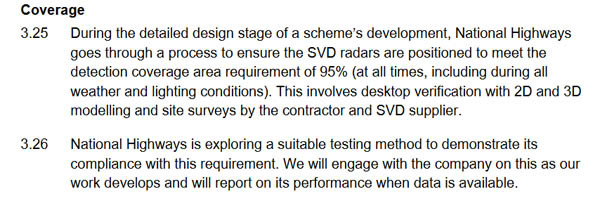
However, in a report published in December, the Office of Rail and Road (ORR) noted that during the detailed design stage of an SVD installation, National Highways goes through a process involving desktop verification with 2D and 3D modelling and site surveys to ensure that radars are positioned to enable maximum coverage.
It added that the government-owned company ‘is exploring a suitable testing method to demonstrate its compliance with [the 95% coverage] requirement'.
Highways asked National Highways to clarify whether it has a method to verify whether an SVD installation is complying with the 95% coverage requirement.
It stated that it checks the placement of the radars against the requirements during the design phase but will then ‘supplement this with post-installation testing to confirm it picks up all the stopped vehicles used during the test'.
This appears to be a reference to a means of testing the detection rate of an SVD system, not the area that it covers, as claimed by Mr Harris. The ORR reported in December that, rather than picking up all stopped vehicles, SVD misses around one in three.
Where the ORR said that National Highways was ‘exploring a suitable testing method to demonstrate its compliance with the 95% requirement, the government-owned company said it continued to explore a suitable ‘alternative' testing method to ‘further' demonstrate its compliance with this requirement.
However, it appears that it does not have any testing method that demonstrates this.
This follows another challenge to Nick Harris last week by the chair of the Transport Select Committee about his inaccurate claim in July that the technology was 'currently achieving' the company's performance requirements.