
The Department for Transport (DfT) and Active Travel England (ATE) have jointly published new statutory guidance for the design and provision of floating bus stops after ministers issued a pause on the controversial designs last year.
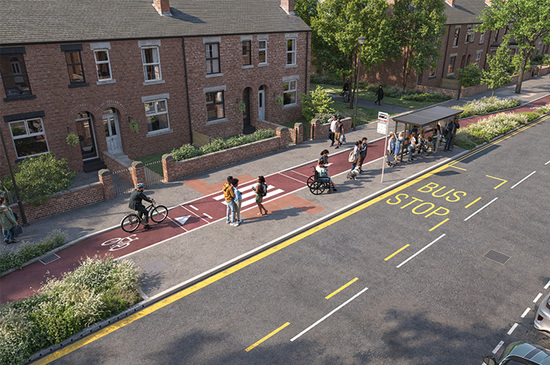
On 20 November 2025, the roads minister Simon Lightwood wrote to all local authorities in England asking them to pause the installation of floating bus stops, which require passengers to board or alight directly from or into a cycle track. The new guidance states: 'This pause is still in place.'
'This guidance should be used to adjust proposed designs which would fall within the pause. Where these designs are already installed, this guidance can be used to make adjustments to them, but it is for local authorities to determine how to apply it to their networks,' the document states.
A DfT spokesperson said: 'Following our pause on some floating bus stops in November, this is the next step to ensuring new bus stops are designed with safety and accessibility at their heart, and we will provide funding to help local authorities make changes to existing sites where appropriate.'
DfT officials briefed Highways magazine that it is statutory guidance under the Bus Services Act 2025, and local traffic authorities, local transport authorities, TfL and National Highways must have regard to it.
Drawing on two reports from Living Streets and Guide Dogs, the new guidance breaks the design process into four key areas:
- Engagement
- User needs
- Assessments and metrics
- Process steps
It states that ‘it is particularly important to gain input from groups representing disabled people and bus passengers', along with local walking and cycling groups, at ‘an early stage of scheme development'.
In order to achieve this, the guidance advises that designers undergo training in the accessibility requirements of disabled people and inclusive design. This training should include ‘pan-impairment' content, be delivered by disabled people, wherever possible, and form part of ongoing professional development.
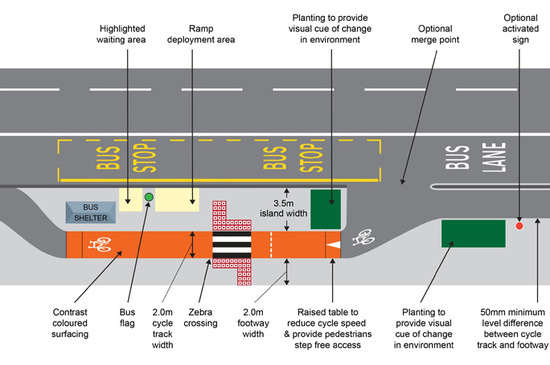
Unusually, the guidance directly alludes to future versions that may develop its initial designs. For instance, in a graphic illustrating the suggested standard layout, it states: 'This layout may be developed further in future guidance. Further guidance will be developed for activated signs, to be informed by research carried out by ATE.'
DfT officials explained to Highways that this research by Active Travel England will look into potential solutions to improve accessibility of these designs and 'be shared in due course'.
Tanya Braun, director of external affairs and fundraising for Living Streets, said: ‘The design of bus stop bypasses has been poor at some locations, leaving blind and visually impaired pedestrians feeling unsafe. We have urgently needed to consider solutions and include disabled people in their design, so the publication of this guidance is a step in the right direction.
‘Our major 2024 study found that problems occur when buses and large numbers of people walking, wheeling and cycling share limited space. While it's good our study is referenced in the guidance, it doesn't answer our call for work to test enhancements in busy locations or address how to help blind people in these environments.
‘We were clear in our study about what is required to make streets as navigable as possible for someone who is blind or partially sighted, such as kerb separation other than at the crossing point and colour contrast. We hope more of our recommendations are taken into consideration in the future versions mentioned in the publication today.'
A key change with this guidance is the inclusion of more nuance when it comes to tackling different types of stops. Graphics lay out options for stops with shared-use bus borders, bus bordering islands and bus stop bypasses. The design process has been broken down into four steps:
- Step 1: Note the desired and minimum widths for a cycle track, a footway and an island at a bus stop bypass or a cycle track with a bus boarding island (whichever is appropriate).
- Step 2: Determine the total width of the site – including carriageway, footway, cycle track and island width.
- Step 3: If the minimum width exceeds the total width available, assess flow for each mode.
- Step 4: Consider contextual justification for smaller widths, including justification based on low or medium flow.
Another change is the inclusion of physical measures to slow cyclists on their approach to floating bus stops.
The guidance said that ‘both Living Streets' and Guide Dogs' research identified poor cyclist behaviour as a factor in how confident people felt at a floating bus stop,' highlighting the failure of cyclists to slow down on the approach to stops and to ‘observe the legal requirement to give way to people' on formal crossings.
To resolve this, it recommends design changes, such as a 50mm minimum level difference between cycle paths and footways or raised tables to reduce cycle speed.
Sustainable mobility design specialist Mark Philpotts (otherwise known as Highways' own Ranty Highwayman) argues that these are examples of ‘traffic engineering, not managing human scale interactions' and argues they could have detrimental effects.
'Measures that might have a chance of slowing the almost mythical "fast cyclist" (probably more about perceptions) will be detrimental to everyone else, especially those using non-standard cycles. The calm street environment that is needed is far wider than just at the bus stop,' he said in a social media post.
'There's a desire for 125mm kerb upstands for cycle tracks through bus stops. *Don't do this*, it's dangerous from a pedal-strike perspective and will reduce the effective width. Table 5-3 of LTN1/20 suggests for kerbs 51 to 150mm high, an additional 200mm of width is required.
'With a 125mm kerb on both sides, 400mm extra is needed. People don't tend to widen cycle tracks, especially at bus stops, so it comes off the usable width. If we end up squeezing in a 1.5m cycle track, that's 1.1m of useable [space] with people concentrating on not hitting kerbs, rather than the bus stop environment ahead. There's also talk of give way markings on the approach to crossing points. Don't do that either because that's contrary to Chapter 3 of the Traffic Signs Manual and pointless in the context.'
He concluded: 'This guidance throws into sharp relief how out of date other guidance is. Pedestrian crossing design is buried in Chapter 6 of the Traffic Signs Manual. We are still waiting for the new Manual for Streets, which after waiting forever, some might say is being rushed out. None of this is statutory either.
'And there is no national guidance for designing for walking/ wheeling (apart from that provided by industry and campaigners) and zero guidance on the most common thing pedestrians have to cross on the street - side road junctions.'
Eleanor Briggs, Guide Dogs head of policy of public affairs and campaigns, said: 'We are pleased to see the continuation of the pause in the updated guidance. The guidance states that local authorities should not install new designs which require passengers to board or alight directly from or into a cycle track.
'We are continuing to review the updated guidance and we are asking for clarification how it will work in practice. We do not think the use of bus stop boarders is safe or appropriate, and any existing designs should be retrofitted.
'We have ongoing concerns about bus stop designs incorporating a cycle path, including those with an island, and so we welcome confirmation from Department for Transport that further research will be carried out on the safety of these designs.'
The full guidance can be found here.