
New stringent rules from the Department for Transport could see individual local councils lose out on incentive funding worth a third of their annual maintenance income if they fail to meet four core tasks.
Under these new regulations, English councils could lose their share of a £525m 'incentive element' removed from the £1.6bn highways maintenance block grant for the 2026/27 financial year, unless councils across England publish transparency reports, which also must demonstrate they are spending all of their allocated highways cash ‘purely on road maintenance' and contain an 'updated asset management policy and strategy'.
Councils must also demonstrate 'continued professional learning', to be confirmed by email to the department no later than 30 November this year.
The DfT added that these reforms ‘respond directly' to recommendations made by the National Audit Office and the Public Accounts Committee, which called for ‘a better understanding of the condition of local roads and more robust monitoring of how funding is being used'.
In a letter to local authorities explaining the new funding and transparency requirements, the DfT outlined the incentive fund requirements along with their weighting and reporting timelines.
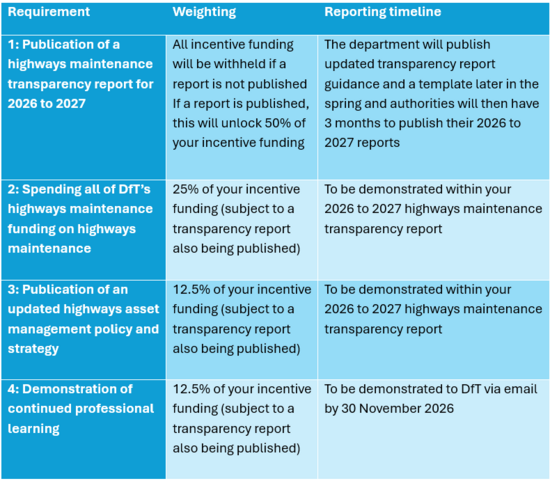
As long as councils meet the criteria for requirement 1, they can expect to see the first 50% of their incentive funding paid in Q3 of 2026-2027, with the remaining 50% paid in Q4, providing they meet incentive fund requirements 2, 3 and 4.
However, should they fail to meet requirement 1, the DfT stated that 'all the authority's incentive funding will be withheld and no incentive fund payments will be made in either quarter 3 or quarter 4 2026 to 2027.
The same is true for Q4, with the DfT explaining that 'if any of the incentive fund requirements 2, 3 or 4 are not met, then the incentive fund payment for quarter 4 2026 to 2027 will be reduced in line with the weightings set out [in the letter]'.
Roads minister, Simon Lightwood, said: ‘Drivers deserve smooth, safe journeys and we're making sure every pound goes straight into fixing roads and tackling potholes, not being spent elsewhere.
‘Fixing our roads is one of the most impactful things we can do to reduce the cost of owning and driving a car and we're making sure every pound goes straight into doing exactly that.
‘We've made it crystal clear that councils that fail to maintain their roads will now risk losing up to a third of their funding.'
RAC head of policy, Simon Williams, added: ‘These measures should go a long way to addressing the poor condition of local roads, which we know from research for the RAC report on motoring is drivers' number-one concern.
‘Ensuring money that is given to councils to improve their roads is actually spent on roads is critical, so the Government's focus on this will be welcomed by drivers. And, while fixing dangerous potholes is vital, it's also very positive to see councils being encouraged to carry out preventative maintenance work, which will stop potholes forming in the future.'
David Shepherd, chair of the ADEPT's Transport & Connectivity Board, said: 'We welcome the government's commitment to accountability and to ensuring investment in local roads delivers real improvements for drivers. Multi-year funding certainty is something local authorities have repeatedly called for over many years, so they can plan effectively and prioritise long-term, preventative maintenance over costly reactive repairs.
'However, withholding up to a third of funding from local authorities that are already managing a £19bn repair backlog risks being counterproductive. Local highway authorities are working hard under significant pressure - from decades of underinvestment, heavier vehicles, severe weather and increasing utility works - and what they need alongside scrutiny is genuine partnership and practical support.
'We are encouraged that red-rated councils will receive expert support. However, transparency and performance frameworks must be fair, clearly understood and allow local authorities to demonstrate the real complexity of maintaining their networks. We look forward to engaging with government on the detail of these new requirements.'
David Giles, chair of the Asphalt Industry Alliance (AIA), responded: ‘We welcomed the Government's commitment to increase funding to 2030, and we support its new measures to ensure it is spent on our local roads and not diverted elsewhere. However, with this year's Annual Local Authority Road Maintenance (ALARM) survey report highlighting that the backlog of repairs now stands at £18.62bn, it is not the silver bullet that will allow local highway engineers to fully deliver the necessary resurfacing and proactive programmes that will prevent potholes forming in the first place.'