
New figures released by the Department for Transport (DfT) this week show limited progress on road safety, with a 4% fall in fatalities between 2024 and 2025 offset by a rise in KSIs and final confirmation that National Highway missed its safety target for RIS 2.
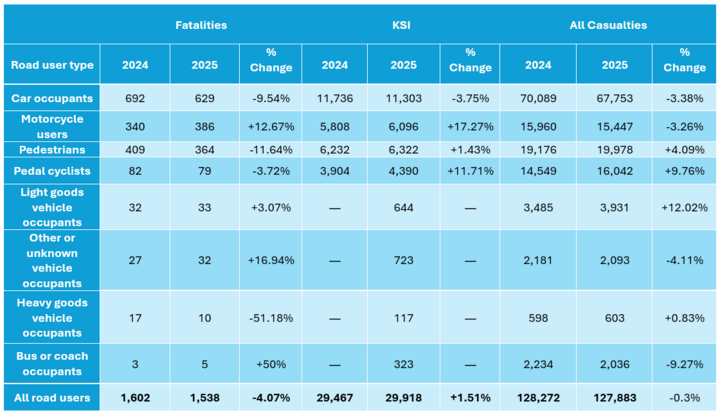
According to the DfT, 2025 had the lowest reported fatalities of any year on record (excluding those impacted by the COVID-19 pandemic), with 1,538 reported road fatalities, 29,918 people killed or seriously injured (KSIs) and 127,883 casualties of all severities.
On top of this, the number of fatalities decreased by 4% from 2024, and 'all severities' saw a slight decrease of 0.3% from the 128,272 figure of 2024.
However, the number of KSIs has actually gone up by 451, representing a 1.5% increase from 29,467 in 2024.

Figures also showed a 3% increase in KSIs from a 2022-2024 average baseline of 28,925 and a matching 3% increase in the number of reported child KSIs (under 16) from 2,353 (2022 to 2024 baseline average) to 2,432 in 2025.
With the new Road Safety Strategy (RSS) setting a target of a 65% reduction in KSIs by 2035, using a 2022-2024 baseline, these latest numbers highlight just how far the nation has to go.
Modal shift in gear
This year's figures have also shown a shift in some of the different transport modes.
Both car and motorcycle users continued the trend of a roughly 3% decrease in overall casualties between 2024 and 2025 (70,089 to 67,753 for car users, 15,960 to 15,447 for motorcycle users).
However, the number of motorcycle user fatalities actually increased by 12.67% from 340 in 2024 to 386 in 2025.
In another disappointing step backwards, pedestrians and cyclists also both saw an increase in overall casualties – 4.09% and 9.76% respectively – although there was progress on active travel fatalities: pedestrians went from 409 deaths in 2024 to 364 in 2025, an 11.64% decrease, and cyclists dropped from 82 in 2024 to 79 in 2025, a 3.72% decrease.
Another interesting aspect highlighted by the report was work-related travel, whether as part of work or as part of a commute to or from work.
Data provided to Highways by the DfT showed that both areas saw a slight decrease. All casualties from travel as part of work went down from 24,234 in 2024 to 22,931 in 2025, with commuting dropping from 19,068 in 2024 to 19,036 in 2025 - that is a 5.5% and 0.16% decrease respectively.
Under the road safety strategy, the Government said it would 'pilot a National Work-Related Road Safety Charter for businesses that require people to drive or ride for them'.
The scheme aims 'to promote good practice, and accountability of organisations and their workers' and success will initially be 'measured on organisational engagement, initial safety impacts and culture change'.
A pilot scheme will run for two years, but no announcement has been made so far on when this will launch.
Strategically falling short
These latest DfT figures also confirmed that National Highways fell short of its RIS 2 safety target by over 12% when compared to the 2005-2009 average baseline of 2,999. This baseline was previously 3,100, but was adjusted by the DfT following an annual severity adjustment that is applied to all serious and slight injury casualties from 2004 onwards. This is done to account for changes in how some police forces record injury severity in recent years and allow trends to be compared consistently over time across the country.
The total number of KSIs on the strategic road network (SRN) in 2025 was 1,875 (a 37.5% reduction), 12.5% short of the second road investment strategy (RIS 2) target of a 50% reduction compared to the 2005-2009 baseline.
As previously reported in Highways, the national roads monitor, the Office of Rail and Road, had predicted for some time that the strategic road authority would fail to meet its safety target.
Prentiss Clarke-Jones, highways safety advisor for the ORR, said: 'In our safety report of December 2023, we required National Highways to develop a plan setting out what additional actions it would take to close the gap to its target. The company finalised the plan in March 2024 and implemented it over the remainder of RP2. It also delivered further actions in 2025 as part of its safety plan for the interim period. The latest statistics, published on 30 July 2026, show that these actions were not sufficient to meet the target.'
A National Highways spokesperson said: 'Every road death is a tragedy, and every serious injury is a life changed which is why we invested in more than 200 targeted safety schemes in this period.
'Traffic increased substantially in 2025, compared to the previous year, which is one of the factors influencing the number of deaths and serious injuries on our network. We have a robust programme to tackle some of the highest risk locations over the next five years, working alongside partners to help reduce the numbers further on our roads.'
To RIS 3 and beyond
One of the long-awaited aspects of the RSS was the introduction of a Road Safety Investigation Branch (RSIB). Originally proposed in 2022, the branch was designed to independently investigate road traffic collisions, analyse systemic safety themes, and evaluate new transport technologies like self-driving vehicles and e-scooters.
While these original plans were scaled back in 2024, the national safety strategy reintroduced the RSIB with a more strategic, thematic approach that focuses on patterns of collisions, injury trends, and systemic safety issues rather than individual incidents.
Despite repeated calls for this to be introduced, however, there has been little progress made since the RSS's launch in January.
When approached by Highways, the DfT was unable to confirm a date for the launch of the RSIB and stated that consultations with road safety stakeholders are currently planned to begin this Autumn.
Correction: The total number of KSIs and percentage reduction have been corrected from 1,876 to 1,875 and from 39.5% to 37.5%, respectively. The percentage difference between the target and what was achieved was also changed from 10.5% to 12.5%.