
Oxfordshire CC recently undertook a two-day trial of 15 different pothole repair techniques in partnership with M Group, kicking off a two-year study to understand which methods are most effective where. Deputy editor George Barker reports.
Situated in the middle of an Oxfordshire industrial site, Wildmere Road in Banbury sees heavy traffic from HGVs, buses and cars – making it a useful site for testing pothole repair methods,
The pothole-pocked road had ample room for the 15 different defect repair methods being trialled over 17 and 18 June. Split across the two days, the first saw the demonstration of standard hot patch material, thermal repair, a demonstration of the M Group Dragon Patcher, and a selection of four cold mix materials from various suppliers.
The second day saw even more variety, with the Bobcat patching machine, RoadMender Mastic Repair, SteelPhalt SteelPatch, MMA Resin Floors Telford, three more cold mix materials, Instarmac Instaband ECO, Swarco ECO Texband, Meon UltraCrack L270 and Meon PermaFyx all out in full force.
Oxfordshire County Council cabinet member for highways construction and repair, Liz Leffman, tells Highways: ‘What we will learn is which of those are most efficient and most cost-effective. We're going to be testing them out over the next two years. So we should learn a lot about the resistance of the materials that we're using.'
Second go round
In 2023, Oxfordshire undertook a similar trial of seven repair methods/materials in East Hanney, comparing them against a benchmark of a traditional pothole repair gang:
- JCB Pothole Pro
- Thermal Repairs
- Mastic Asphalt
- Cold Permanent Repair using Electric tools
- M Group Dragon Patcher
- Paco Patch
- Bobcat/Mini Planer Patching Gang
Thanks to this trial, the council now makes use of the Bobcat planer, thermal repairs, and mastic repairs on Oxfordshire's network, in addition to the M Group Dragon Patcher, which has reportedly been in use in Oxfordshire ‘for some years'.
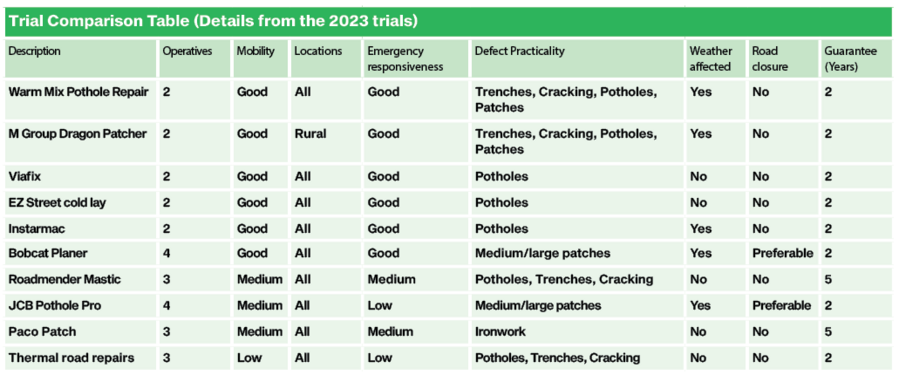
The latest trial included these older techniques once again to gather fresh data on how they perform compared to newer solutions.
According to Phil Raven, operations manager at M Group, there have been ‘many new materials' that have come to market since 2023 and the company was ‘keen to make use of advances in technology' with evidence to guide decision-making.
‘By conducting the trial on one road,' he adds, ‘we can get a like-for-like comparison. We can also compare results from the 2023 trial which was carried out on a rural road, [to future results from] the 2026 trial which took place on an industrial estate, heavily trafficked by HGVs and other large vehicles.'
Weather-dependent
Cllr Leffman highlighted a focus on ensuring that pothole repairs are more resilient to extreme weather like the winter storms we saw just last year.
‘We've got climate change. We know we've got lots and lots of rain in the winter, so we need potholes that are resilient to all of that. So what we'll learn from this will be what the best methods are in which locations.'
When it came to selecting what methods would be given their time to shine over the next two years, Richard Lovewell, business director for M Group, said that they left that decision to a fairly open invite.
‘We went to our subcontractors and to our suppliers, and just said "look, what materials have you got?"'
Of course, this wasn't the only way that the chosen 15 were sourced; M Group also made use of the trade press (a wise choice) and advertisements from suppliers.
‘We also made use of the wider M group. We do a huge amount of utilities work around energy and water, and [that sector of M Group] has different suppliers than us. And again, there's crossover between the large businesses in M Group, so we can learn from each other across those areas.
‘We maintain a huge number of airports as part of M group, and obviously, they need to be durable. They need to be set really quickly, and again, if there are things that we can learn from what they're doing on the airport side of the business, we can bring it across and see if it can be used on the highways.'
Over the next two years, the council and M Group will be keeping a close eye on each of the repairs.
Mr Lovewell said: ‘We've got a monitoring programme, so we'll do it over weeks initially, then months, and then obviously we'll go back a year later and 18 months later.
‘That doesn't mean we need to wait 18 months, because, generally, with this type of repair, we'll be able to see its durability, certainly, after six months. And that allows us to look at our material palettes, to look at the various techniques.'
When asked what he thought the most exciting of all the techniques on show over the two days was, Mr Lovewell was torn.
‘I guess the proof of the pudding will be in the eating. It's great to try all the different materials. [We saw] the Dragon Patcher down here yesterday. We've got the mastic asphalt, that, again, has its place in that Swiss army knife of the type of things that we do.
‘[However] It's the cold mix, I think, that is the most exciting. Everybody in the country suffered this year, with 40 days of continuous rain, so if we can find a cost-effective, durable, cold lay product that we could potentially use in an extended wet period, then that is making sure that we're delivering a far more efficient service to our client.'
With the clock started on the two-year monitoring, it may be a little while yet, but hopefully, once the results are in we can all enjoy ‘the pudding'.