
JCB partnered with the Welsh Government to provide up-close, but more importantly personal, insight into the JCB Pothole Pro, a three-in-one machine intended to boost the efficiency of defect repairs.
It is something of an open secret in the highways industry that the Welsh market can be a tough nut to crack. So, it is probably testimony to the sector's interest in the famous Pothole Pro that JCB's Cardiff demonstration day this Spring had a generous crowd of local authority and Welsh Government officers in attendance. Full disclosure: it was also an unseasonably warm day and there was a free lunch.
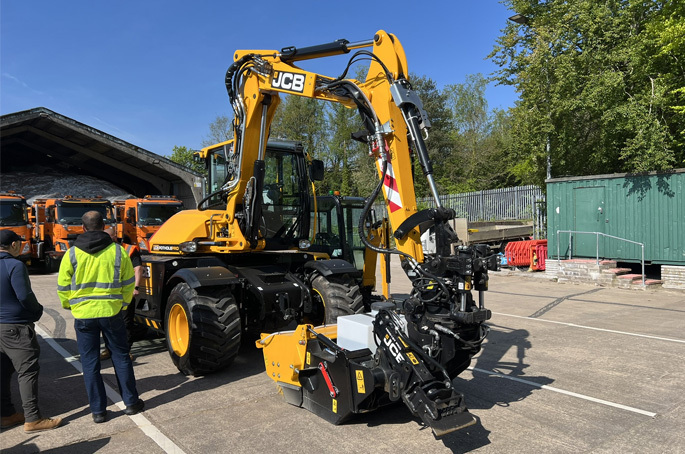
The market by now is no stranger to the Pothole Pro and as you would expect the demonstration itself went off perfectly. Despite the pressure of the assembled great and good watching on at a safe but close distance, Richard Matthews, senior demonstrator for JCB, gave the people what they wanted; in just a few minutes he planed out, cropped and swept clear a pothole. Rapid and seamless preparation work is the key selling point of the 3-in-1 machine, as JCB identified productivity as the main opportunity in the road repairs market.
JCB's national highways manager UK and Ireland, Allan Wallace, gave a recap on how the Pothole Pro came into being: ‘There are a lot of solutions out there: even small tractors with a planer on it, the kind of thing you could come up with in the shed. But this machine was designed from the ground up to take away the hazards, to make it very safe and to do everything from the cab, so one operator can clean out the hole, crop the hole and then sweep it up: the three main jobs of preparing a perfect pothole patch. So, rather than get a road sweeper on site, which is normally about £650 to £1000 a day, you don't need that additional vehicle. We also gave it a 40km road speed so we could travel to site quickly.'
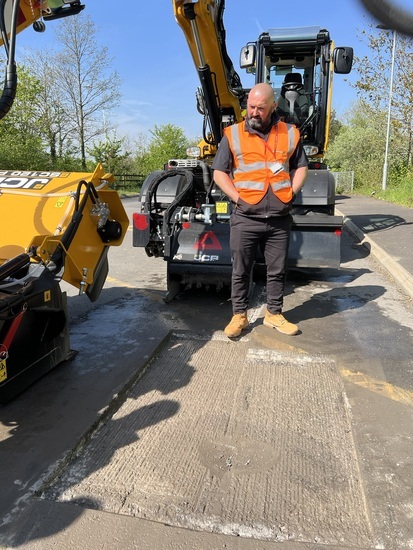
The demo was preceded by a detailed walkthrough of the machine, highlighting features such as the water tank that feeds to the planer; this fluid drip reduces wear and damage to the planer's teeth through cooling; the high glass cab that allows the operator a clear view of the works and surrounding area and the 400mm cropping tool that can prepare a uniform hole profile.
Slick as JCB's sales pitches always are, the main selling point and highlight of the day didn't come from Mr Wallace, or even the machine itself, it came from the people who use the Pothole Pro.
‘The problem we have is, well, everybody wants the machine. All the guys who are on the normal surfacing teams, they all want to work with the Pothole Pro because it's much easier,' said Ken Evans, operations director for Centregreat - known as ‘Mr Wales' due to his storied career in the devolved nation.
He told Highways: ‘We were looking for something that could be repair potholes quickly, with "right first time" repairs and very little failures. We looked at a number of options and we thought the Pothole Pro was just that sort of thing that we were looking for. We've had it for a couple of years now. It's really, really good. It's very quick to use as well. And the thing about it is, it standardises the repair, especially on the joints and everything. That means you don't get any wastage of material as well. We find it's very good for the workforce as well as saving on time and money.'
In terms of practical advice, he suggests: ‘It's important that you know the route that it's going to take in the morning. If you make sure that its consistent, that's when you can get the maximum efficiency out of the machine, by pre-planning everything.'
Mr Matthews told Highways: ‘I have worked on a lot of machines. With the Pothole Pro you are higher up, you've got the extra visibility around you, you've got a lot more power, you also have the comfort inside the cab as well. And you've got all the functions in the cab that you need.
‘We advise talking to your operators and taking on the training that JCB provides and basically just learning the machine is a good machine to use.'
JCB offers a free two-day Pothole Pro demonstration with an operator:
‘We'll come to site and work with your own road crew to let you see the machine working in your own environment and then judge for yourself,' Mr Wallace concludes.
A difficult offer to refuse, even if there is no free lunch.